Staffing Industry Spotlight: Jeff Nugent
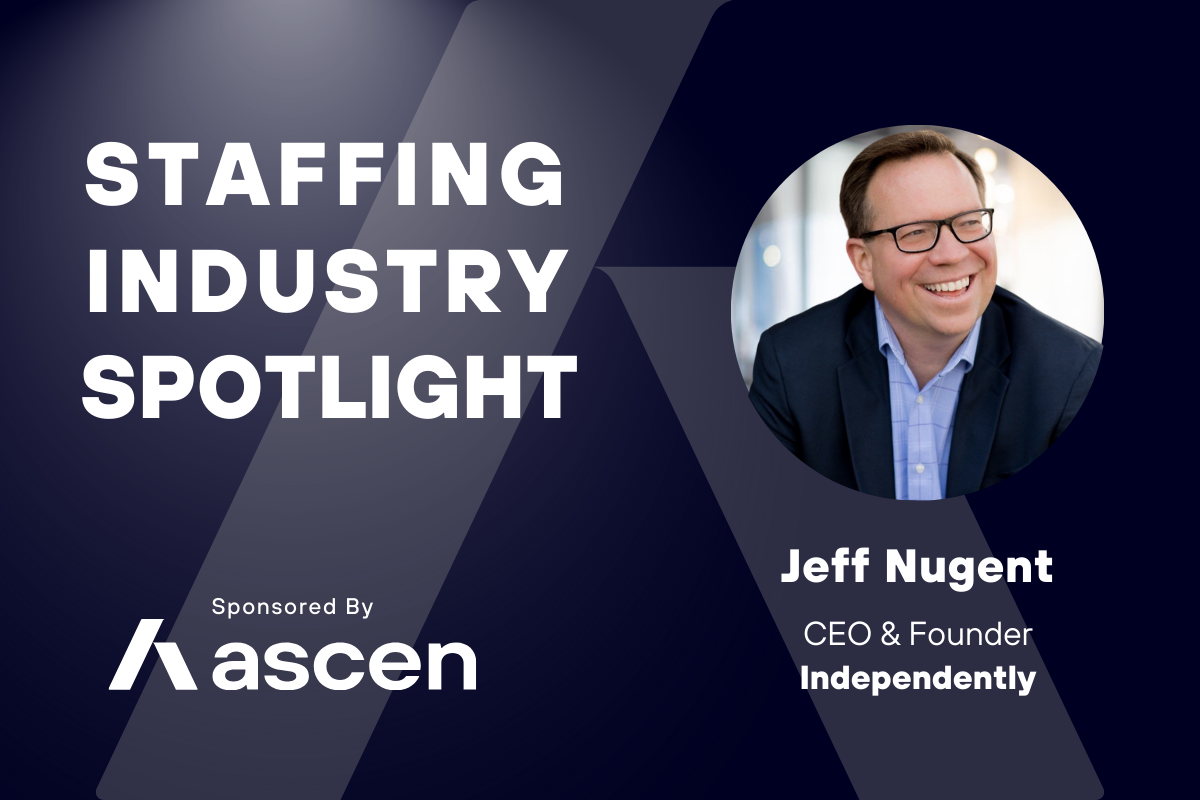
In this installment of Staffing Industry Spotlight (sponsored by Ascen, a leading back-office and employer-of-record for staffing agencies), we sit down with Jeff Nugent, the CEO and Founder of Independently.
With a career spanning from the early days of "old school" staffing to scaling and selling a global multimillion-dollar EOR, he brings a wealth of experience to the evolving contingent workforce landscape. In this discussion, Jeff dives into the complexities of independent contractor classification, the critical intersection of technology and insurance, and the limitations of AI in making nuanced judgment calls. He also highlights the vital role of worker education in mitigating audit risks and offers actionable strategies for staffing firms to navigate the global shift toward a fractional and freelance-driven economy.
Francis Larson:
Jeff, thank you so much for being on the Staffing Industry Spotlight. The first thing we would like to know is who you are and what you do.
Jeff Nugent:
I’m Jeff Nugent. I’ve been around the industry for a very long time and have evolved with it. I was lucky to start during the "old school" era of staffing. Resumes were brought from desk to desk on a cart with folders. You would flip through them, run over to the fax machine, and fax them to your clients. This was during the run-up to Y2K, so anyone with mainframe skills was in high demand.
In the late 90s, we moved into technology with Applicant Tracking Systems, building them ourselves and handling matching. From there, I evolved into the contingent workforce space. We created the first VMS in Canada called FlexTrack. I was the founder, and we built it from a basic timesheet system into a full-functioning VMS. As an entrepreneur, I eventually asked why I was doing this for someone else, especially someone who didn't understand how the staffing industry was evolving with centralized management.
I went on to start a company called Contingent Workforce Solutions, which was a pure-play Employer of Record. We built that to a level where, around 2017, we started a conversation with People 2.0. At the time, they were about the same size as us—around $100 to $150 million in revenue. They handled Employer of Record and back-office services for staffing agencies. We merged, went on an M&A rampage worldwide, bought 14 or 15 companies in 24 months, and sold the company in 2021 to a large private equity firm.
Recently, I noticed a trend toward freelancers and independent contractors. It was there before, but it accelerated after the pandemic, with remote work. I built an app called Independently that helps solve the complexity and inconsistency around independent contractor misclassification. We are a standalone, independent third party not tied to any staffing firm or EOR. Similar to a background check, we validate independent contractor status and then guarantee those results with insurance. Large enterprises adopt us so they have a consistent methodology across their supply chain for validating ICs and holding a defense file for perpetuity.
Francis Larson:
Were you doing any independent contractor work back with Contingent Workforce Solutions, or was it all Employer of Record?
Jeff Nugent:
We were in EOR as well. Going back to the IT staffing company in Canada—as with many jurisdictions—there are high personal tax rates for high-income earners and lower business tax rates. In Canada, if you earn between $100,000 and $200,000, you are taxed at 54% on every dollar after that. However, if you incorporate as a small business, you can write things off, and your net profit is taxed at 15%. You keep a lot more in your pocket. Most people keep it in the corporation as a deferred tax strategy. I cut my teeth in independent contracting there, learning all the regulations. I sat on government committees as an expert when legislation changed. I am a huge proponent of self-employment. Part of my passion is helping people become self-employed. It is complex, but with the right tools, it’s a great way to build a career.
Francis Larson:
Independently does a lot of things, including record-keeping for a defense file. On the determination side, what do you see companies getting most wrong about IC classification?
Jeff Nugent:
There are many nuances due to the different levels of government. You have rules at a federal level, a state level, and then worker's compensation levels where the laws are often different if someone gets hurt. Across the 50 states and the 50-plus countries we cover, the complexity is ridiculous.
Regarding what they get wrong, I think it comes down to mindset. You have to remember that this is a client-vendor relationship. An independent contractor is actually a vendor. It has a pseudo-employee nuance, but if you take a step back and treat them as a vendor, you start to get things right—especially around behavioral control. Do you control their work hours or the way they get the job done? Or are you just providing high-level requirements because they have the expertise to do it themselves? Then you look at the other side: Do they have a business setup and investment in their business?
Most people are more worried about starting the bill on Tuesday than about getting the paperwork done. We invented Independently to speed up that process and complete the file. When the bill starts on Tuesday, and the worker starts getting paid, the file often never gets completed.
Francis Larson:
You mentioned algorithms for these factors. How does AI play into this classification? Is there a place where it is particularly weak?
Jeff Nugent:
We have been testing AI since the company's inception. It’s a great tool for helping us catch anomalies, parse data from documents, and reduce manual processes. However, we will never have AI make the judgment calls. We have tested it extensively and found the error percentages are unacceptable. It makes things up. You see headlines now about lawyers submitting legal opinions generated by AI that referenced cases that weren't even real. The courts do not look highly on that. Independently does not provide legal advice; we are an app that has been built with advice from lawyers to create an automated workflow for employer decision-making.
Francis Larson:
Globally, where is it toughest to employ freelancers as independent contractors?
Jeff Nugent:
There is a ton of commonality, which is interesting. Europe is very employee-friendly and has a strong union presence, so there is significant pushback against independent contractors. Part of that is because there isn't clarity or trust that people are doing it right. Uber led the charge by lobbying against regulatory changes rather than doing it correctly. If every driver had an LLC, proper insurance, and understood they were running a business with an accountant and paying taxes, it would build trust. Unfortunately, many digital freelance management systems view compliance as a friction point for revenue. They think about revenue first and ask for forgiveness second. They ignore laws developed over a hundred years to protect workers and government tax streams.
Francis Larson:
I saw a demo of Independently about a year ago. One thing that stood out was the effort to ensure the worker understood that this was an independent contractor engagement and that they were self-employed. Why is that so important?
Jeff Nugent:
The number one trigger of an audit or a lawsuit is a disgruntled worker or someone getting hurt. A disgruntled worker who didn't realize they weren't eligible for unemployment insurance or severance pay is the primary risk. Making the experience easy for the worker while relying heavily on education ensures they understand what they are getting into.
In our app, we have a big button that explains the pros and cons. You aren't protected under the Employment Standards Act; you are working to the terms of an agreement, which could mean zero notice, and you are responsible for your own benefits and taxes. If they are scared and want to be an employee, that's fine. But if they choose it, they are educated. We track all of that—the interview answers, their IP address, and the location where they clicked that button. When an auditor or lawyer claims the worker was misinformed, we can show our due diligence.
Francis Larson:
A nefarious client or agency could help someone get an entity or insurance without the worker truly understanding the implications. Is that why you still ask them those questions even if they have the business indicia?
Jeff Nugent:
First and foremost, it’s about money. The government wants its payroll taxes. If a worker gets hurt, there is a financial benefit being an employee if they don't have their own insurance. The law doesn't automatically say you are an IC just because you have an entity. That is a myth in our industry. It is a strong indicator of business investment, and we recommend our clients make it part of their procurement policy, but it doesn't clear you 100%.
Having insurance in place prevents liability from even reaching the employer. If they have worker's comp and something happens, their policy pays out. If they are getting paid, they don't come after the employer for the claim. We’ve seen cases where a company has a bunch of incorporated help desk people making $20 an hour. There was no reason for them to set up businesses other than being told they would get a few extra bucks on their rate. They were losing all the protections of an employee.
We educate workers on the regulations and on running a small business. In the US, you can set up an LLC for $199 with 12 clicks. We have facilitated partnerships to provide discounted business setups and fractional insurance. Back in the day, a policy might have been a $5,000 minimum; now it can be $10 or $30 a month. For someone making $25,000 a month, not spending $30 to be covered doesn't make sense. We also have to educate the managers. Often, a manager hears a worker complaining about the "hassle" of compliance and defends the worker against the policy. They don't realize they are actually harming the company and the worker by not ensuring they are covered for a catastrophic situation.
Francis Larson:
It really is an educational thing. This has been very illuminating regarding the contingent space. Thank you for being on the show.
Jeff Nugent:
I love it, Francis. Thank you for inviting me. We always have great conversations, and it’s always a pleasure.




.png)