Staffing Industry Spotlight: Joey Frampus
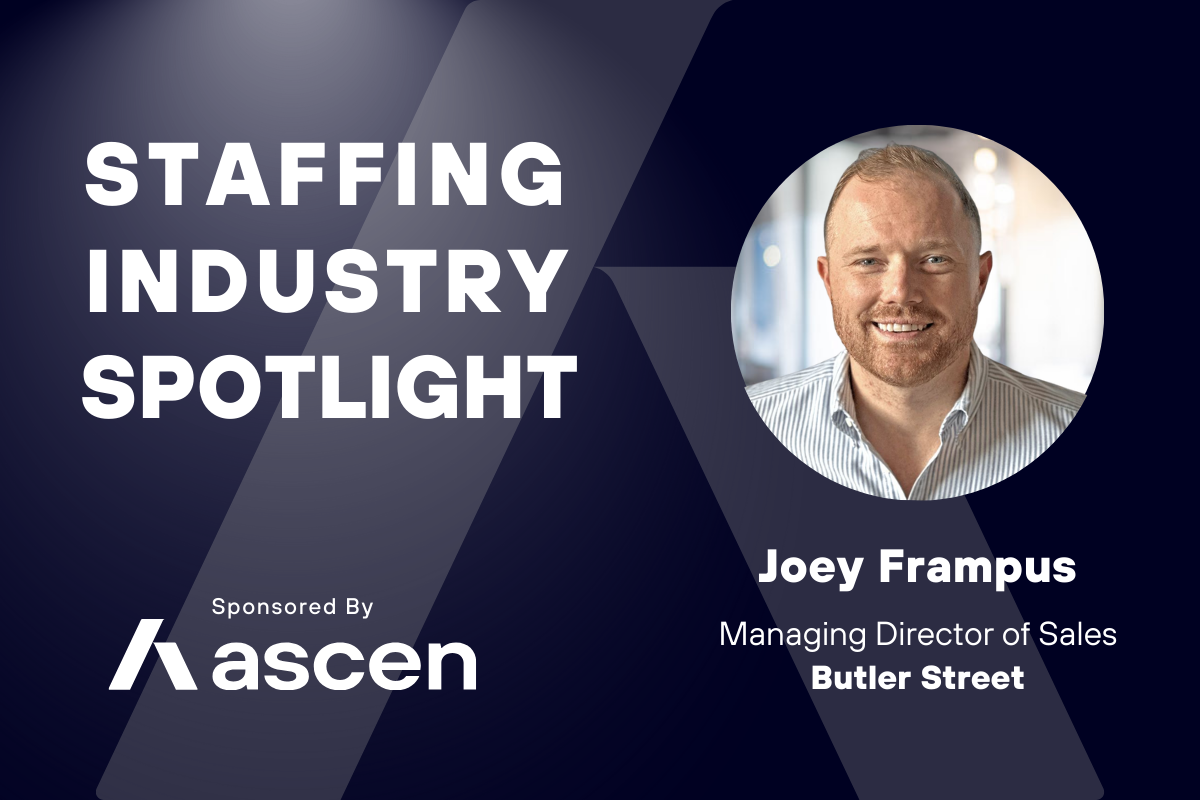
In this installment of Staffing Industry Spotlight (sponsored by Ascen, a leading back-office and employer-of-record for staffing agencies), we welcome Joey Frampus, the Managing Director of Sales at Butler Street, a management consulting, training, and research firm.
Joey shares practical staffing growth strategies, leadership and sales “easy wins,” TAM insights, how MSP-driven buying is changing, and real-world AI use cases that improve outreach, meetings, and fill rates.
Francis Larson (Ascen)
Joey, we appreciate you being on Staffing Industry Spotlight. The first thing we'd like to know is who you are and what you do.
Joey Frampus
Thanks for having me. I’m Joey Frampus, the Managing Director of Sales at Butler Street. I’ve been in staffing for 13 years. Like many people, I tripped into it after graduating college in 2011, when no one was hiring. I worked for one of the major firms for a decade, spending time in St. Louis, Detroit, Dallas, and Atlanta. I ran our domestic expansion for two years, opening staffing offices in ten different cities. I then went to a startup that didn’t quite take off, and eventually found my way to Butler Street.
Butler Street is a growth and consulting partner specifically for the staffing industry. We help build professional development programs focused on leadership and sales skills. We’ve even developed an AI training path to help people use AI more effectively and tailor all of our solutions and programs to the customer. I think of myself as a player-coach—I manage the sales at Butler Street while also managing my own book of business with customers.
Francis Larson (Ascen)
So you're actually doing training as well.
Joey Frampus
Exactly. Training, consulting, internal team management, cold calling, speaking at conferences—it’s been a cool experience. After being with one firm for a decade, I didn’t realize how many different ways there are to do staffing. There are 29,000 staffing firms in the U.S., and everyone has their own touch. The market is big enough for everyone to play in the sandbox.
Francis Larson (Ascen)
Regarding leadership and sales, what are some "easy wins" or basic-level consultations on sales that every staffing firm needs?
Joey Frampus
It’s easier to start with leadership because it trickles down. First: understand your strategy. We ask companies about their growth strategy and they often say "all of it." We have to simplify that. There are three main ways to grow:
- Grow your current accounts (expand your footprint).
- Acquire new accounts.
- Diversify what you are selling (e.g., an IT firm starting to sell engineering or finance).
Those are the three main strategies without pinching margins. Leadership needs a clear vision of where they want to go and must communicate that effectively to their teams. Your strategy is only as good as your ability to articulate it. We see a big gap there because while the goal is often "both," there isn't a defined plan for how to achieve either.
Francis Larson (Ascen)
What’s an example of an overarching strategy for acquiring new accounts?
Joey Frampus
You have to define your target persona and segment. For example, if you're in the Midwest and have success in mid-market banking, focus specifically on financial institutions in that region with a certain revenue and employee count. That is a real strategy for account expansion.
For growing existing accounts, the first step is understanding the Total Addressable Market (TAM). I use an analogy: if your son goes trick-or-treating in a subdivision of 100 houses and he isn't allowed to leave that area, his TAM is 100 doors. If he only gets to 50, he’s at 50%. As account managers and leaders, you need to know the total staffing spend at a company. Is it $1 million or $100 million? You need to know your market share. I used to lead teams without knowing if having 10 contractors at an account was good or bad until I found out the client had 1,000 contractors total. Once you know the spend, you can build an action plan.
Francis Larson (Ascen)
Are clients hesitant to give up that information?
Joey Frampus
No, you just have to ask. A line manager might not know, but a Director, VP, or Head of Procurement will. You frame it as wanting to provide the best service. If the spend is higher than you thought, you can justify adding more support or another person to the account. It’s about what’s in it for the customer.
Francis Larson (Ascen)
You mentioned diversifying. Is that about expanding personas or diversifying the offering?
Joey Frampus
It’s a bit of both. In IT, moving from software development to infrastructure isn't a big jump. But in banking, you might realize they have more spend in finance and accounting. That’s when you expand to talk to the Controller or the Manager of FP&A. It’s the same "sport," just a different "game"—like switching from basketball to baseball. Salespeople can adapt to that, especially with the tools we have now to understand what a Controller thinks versus an IT Director.
Francis Larson (Ascen)
Is it realistic for an IT firm to suddenly start staffing finance roles just because a bank says they have $10 million in spend there?
Joey Frampus
It comes down to resourcing. If you have a successful IT account manager, do you want to pull their attention away? If you have someone struggling whom you believe in, maybe you can give them that new vertical to find success.
There are two camps in staffing: the specialists who only do one thing (like ERP or Cyber Security) and those who follow the customer wherever they go. Specialization has power, but it limits your growth. If you want hyper-growth, you have to be willing to take risks. When I ran domestic expansion for a large firm, we would open offices specifically because a customer asked us to be in that market. If the demand is high enough, you do it.
Francis Larson (Ascen)
How does an executive leader make sure this scales through the organization?
Joey Frampus
It depends on the middle management layer. Are they just regurgitating what the executive says, or are they owning the message? Middle managers must understand the strategy and communicate it effectively.
Also, we need inspiring leaders. Nobody wakes up hoping they won't be inspired that day. During the last few years of industry struggle, it's been hard to find that. Finally, it's about the day-to-day: how are you interacting with customers, building relationships, and asking the right questions to uncover their pain?
The way customers buy staffing is evolving. MSPs (Managed Service Providers) are now in 80% of Fortune 1000 companies. Salespeople need to adapt to that. My old boss used to say, "If they’ve never bought staffing before, you aren't going to convince them to start now." You have to meet the customer where they are and sell the value of your company holistically.
Francis Larson (Ascen)
How do you practically make buying easy for a customer?
Joey Frampus
The manager should be able to offload the onboarding process to the staffing firm. What does the candidate journey look like? How is the firm communicating with the candidate during interviews and after placement? If you place a candidate and never talk to them again, that reflects poorly on your firm. Elite firms own the orientation, the ongoing care, and the regular reviews with both the consultant and the manager. It takes discipline and time, but that’s what the best firms do.
Francis Larson (Ascen)
Is there anything else regarding ongoing training that salespeople need?
Joey Frampus
I would say preparation, being coachable, and always being willing to try something new, because what made you successful in 2019 isn’t necessarily going to be successful in 2026. It’s crucial to continuously develop our skills.
Francis Larson (Ascen)
Let's talk about AI. What are the effective and ineffective uses of AI in sales right now?
Joey Frampus
The ineffective way is a "one-size-fits-all" approach. If I see a LinkedIn post full of emojis, I know it was made by AI. At Butler Street, our mantra is "AI + EQ + Habit = Sales Success."
Effective uses include customer research. Using AI tools to research a prospect is incredibly powerful. Before this call, I used AI to see that you had an incredible senior season as a catcher. I’m not going to go dig through a university website for that, but I can find it in 30 seconds with AI. I’ve also used AI to summarize a customer’s podcast appearance so I could reference their specific points and even their family members' names. It shows you did your homework. Being able to reference those "nuggets" shows a higher level of care.
We’ve also developed AI sales coaches. Salespeople love shortcuts and hate administrative tasks. If AI can help with rebuttals or analyzing why a manager rejected a resume, it saves time. You can put a job description and a resume into a co-pilot, ask it to analyze the gap, and then use that data to call the manager and sell the candidate back in. That is a different skill set than just taking a rejection at face value.
Francis Larson (Ascen)
What is the biggest common problem you hear from clients that AI can solve?
Joey Frampus
Meeting activity. Outreach is different post-COVID. You can't just call a desk line five times a day anymore—people use cell phones and they will block you. We see low meeting counts, higher competition, and fewer opportunities. Because there are fewer opportunities, your fill rate must increase.
A lot of people became "glorified order takers" because demand was so high post-COVID. Now they actually have to be salespeople again. That means learning how to run an effective meeting with an agenda, mapped-out questions, and a clear goal. AI can help coach them through those basics of salesmanship.
Francis Larson (Ascen)
For staffing firms under $25 million trying to break through, what is your final piece of advice?
Joey Frampus
Develop your people: You’re only as good as your team. Turnover is expensive for your P&L and your brand. 2. Embrace AI: Smaller companies can be more nimble. Look at AI dialers and tools that offload manual work so your people can focus on high-value tasks. 3. Define your strategy: Know exactly how you plan to grow. 4. Don’t be afraid to say yes: Meet your customers where they are rather than expecting them to come to you.