Staffing Industry Spotlight: Greg Fischer
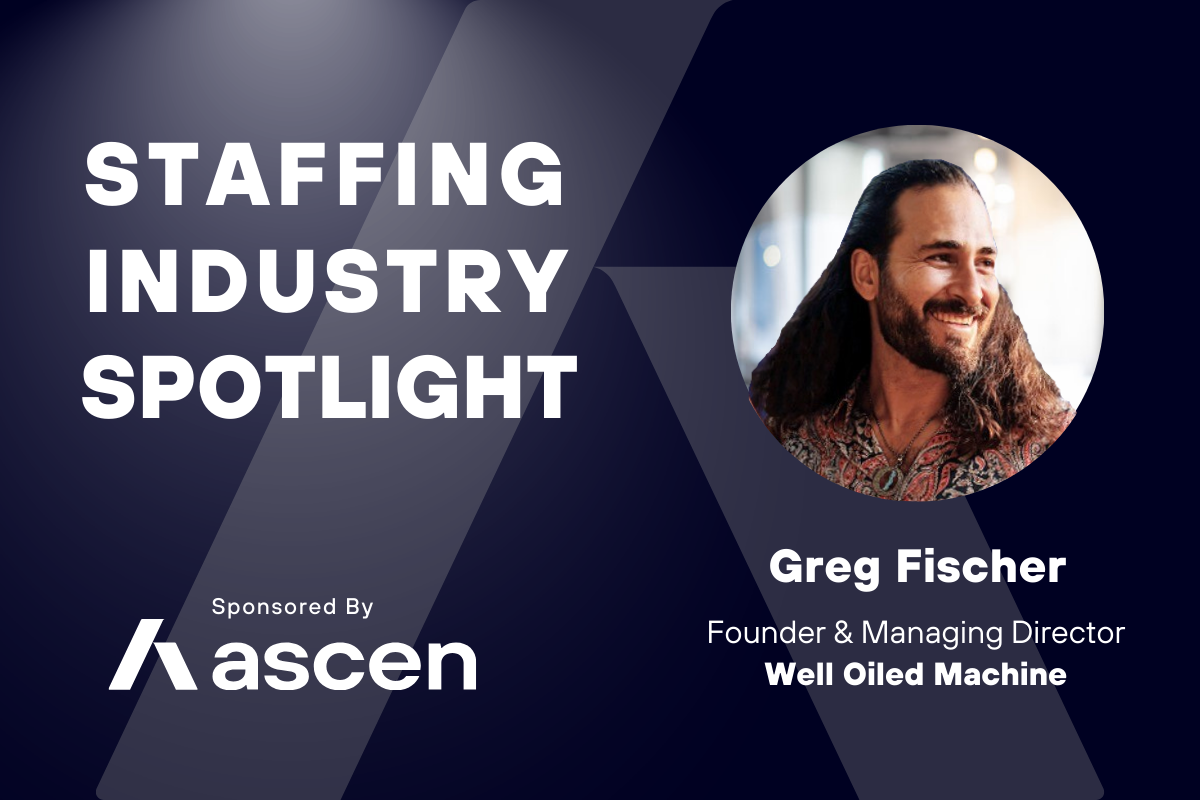
Staffing Industry Spotlight is an interview series featuring leaders shaping the staffing industry, sponsored by Ascen, a leading back-office and employer-of-record for staffing agencies. In this episode, we sit down with , the Founder & Managing Director of Well Oiled Machine, who shares his journey from gym management to scaling a recruitment agency from $1M to $4M using international talent.
Greg provides a masterclass on offshoring strategies, discussing how to identify the best global sourcing and recruiting hubs, the critical importance of hyper-specialization over generalist roles, and why firm "ownership" of training is the deciding factor in success. He also offers a pragmatic look at the future of AI in recruitment, explaining how global talent provides the necessary human layer to refine and upskill automated sourcing.
Francis Larson:
Gregory, thank you so much for being on the Staffing Industry Spotlight. First thing we'd like to know is who you are and what you do.
Greg Fischer:
My name is Greg Fischer, happy to be here. I am the founder and managing director of Well Oiled Machine. It’s always hard to talk about what we do because we're a little bit different from everyone else. Technically, we are a rec-to-rec recruitment firm, so we recruit recruiters for recruitment firms. Part of what makes us different is that we do it internationally. We specialize in hiring the top 1% of recruiters in Latin America, Africa, and Asia.
Francis Larson:
I know from your background that your route into this business was pretty unusual. I’d love to hear that because I know you didn’t start in this industry. How did you end up founding Well Oiled Machine?
Greg Fischer:
Like most people, I fell into recruitment. I managed gyms and was being recruited for a job, and ultimately he hired me instead of recruiting me for his client. We always joke about whether he wishes he got the fee for me instead of me working for him.
I fell into recruitment about 12 years ago. I was the first recruiter hired at this agency. As we started to scale, profit margins were tight. We needed to find more cost-effective ways to source candidates and clients, and we fell into recruiting international employees. The first four times, it went horribly wrong. We wasted a lot of time and money trying to work with agencies or freelancers on Upwork. Eventually, we figured things out. Within a few years, we went from a million-dollar agency to a four-million-dollar agency. Eighteen of our 38 team members were international. We got to see firsthand that it doesn't matter where you sit, but who you are and what you're capable of.
It felt like a cheat code. We were hiring team members who were just as capable as their US counterparts at a quarter to a fifth of the cost. After 10 years at the agency, I realized that my values and the primary owner's were very different. I decided to leave and began consulting. I thought I would teach recruitment firms to build what I did.
As I started getting into it, I had a ton of sales calls. I was so excited to build this consultancy. Very quickly, I’d tell people, "Here is where you should hire for this job, and here is what you should pay." Everyone said, "Great, let’s do it." Then I’d say, "Now let's talk about how you'll go find your people," and they’d ask, "Can you do that for me?" I’d tell them I was just the consultant and they should recruit the recruiters themselves. They told me their time was better spent recruiting for big placement fees and asked me to do it. After seeing this gap so many times where things fell apart, I realized there was clearly a demand. Nobody was going out and recruiting the best of the best, so I needed to start an agency to do that. I did that back in July, and since then, we've been taking off like a rocket ship.
Francis Larson:
July was very recent. That's crazy. When you were doing this in the previous agency, were those international team members in recruiting-type roles?
Greg Fischer:
Yes. We started off with more entry-level roles, which is where I suggest people start. Sometimes people say they want to hire a salesperson in Mexico, and I tell them that probably shouldn't be their first hire. Start simple, then work toward more complex roles.
Our initial hires were sales researchers—people who would spend 40 hours a week scraping Indeed and LinkedIn for the right job ads, researching companies, finding decision-makers, and validating contact information. Eventually, we added sourcers, which our recruiters loved. We were able to bump our US-based recruiter goals by 25% simply by saying they no longer had to source. Eventually, we added recruiters who handled the full cycle of recruitment for some of our more entry-level roles, and then we added a couple of SDRs who hit the phones and set appointments for our account executives.
Francis Larson:
Now with Well Oiled Machine, does it span the stack across different roles, or is it primarily focused on recruiting and sourcing?
Greg Fischer:
We only work with recruitment firms and staffing agencies. There are about five jobs in that space, and we do all of them. Most commonly, it's sourcers, researchers, and 180 recruiters. However, there are 360 recruiters based outside of the US that will build huge books of business. There are SDRs, and sometimes we get into the back-office side of things, too. We recently found a bookkeeper and a payroll specialist.
Francis Larson:
I'm surprised more firms—I mean, a lot of firms did this 20 years ago by setting up India shops. Where do you see most US staffing firms looking now? Do they care about time zones or cost? What drives where they find people?
Greg Fischer:
This is part of the fun of it. When we work with clients, we actually help to answer these questions because there's no universal answer. One of my problems is you have all these agencies saying, "We have recruiters in India," which is great if that's the right spot. In some scenarios, India is amazing. We just placed an Indian-based sourcer in the tech space. But sometimes, you absolutely don't want to hire there.
In general, for more administrative positions like sourcing or sales research, Asia tends to make the most sense because the costs are much lower. However, you tend to struggle more with language barriers and getting on the phone. Often, people hire a really good sourcer but then try to have them recruit, and they aren't set up to do that. When it's more recruitment-based—a full-cycle recruiter or even an associate recruiter who screens candidates and hands them off—Latin America tends to be better. If they do a lot of European recruitment, South Africa and Nigeria are phenomenal.
Francis Larson:
That's a very helpful heuristic. You said South Africa and Nigeria are the top two hubs in Africa aligned with Europe?
Greg Fischer:
Yes, those are the top two that are really aligned with Europe. The other piece is cultural. A lot of people ask whether someone speaks good English. The way English is taught in most parts of the world is very formal. But in the US, we speak the opposite of formal. When you hear someone talk very formally, it can feel uncomfortable. With Latin America, and especially Mexico, there's so much overlap with the US. People are visiting back and forth so much that you tend to find much more informal English. Even if there's an accent, it feels very natural.
Francis Larson:
Talk about the cost difference from somewhere like Southeast Asia, Latin America, and South Africa. Is there a wide range in annual salary for these roles?
Greg Fischer:
Relative to US or UK salaries, it's actually a very narrow range. But relative to each other, it's a big difference. A great, reliable sourcer in Asia will have a base salary of $800 to $1,200 per month. You can technically get lower, but you start to run into reliability issues because you’re paying bottom-market rates. Usually, you throw in a bit of commission and target maybe $1,500 or $1,600 a month.
In Latin America, a sourcer might start in the mid- to high $1,000s. When we work with a client, we usually tell them that $1,700 to $2,200 a month will get them a stellar sourcer plus some commission. I like to go to Latin America for people who can start in more junior recruitment roles and eventually take over full-cycle recruitment. For someone like that with truly flawless English, you’re looking at $2,500 to $3,500 a month. This is someone who moved to the US at 10, is totally comfortable, and comes from an established agency. In India, you might recruit someone from a BPO who follows a process but struggles to adapt on the phone. In Mexico, you find someone who comes from Michael Page, Robert Half, or Korn Ferry and understands what it means to hit KPIs.
Francis Larson:
For that junior recruiter in Latin America, would it be $3,000 in every country, or is there a big variance between somewhere like Argentina versus Colombia?
Greg Fischer:
Generally speaking, no. Most Latin American countries are within 10% of each other. Where you find variance is in Argentina, Uruguay, and Costa Rica. Those three cost way more—probably 20% to 30% more—because the cost of living there is much higher. Usually, we go to those three last.
Francis Larson:
You really have to be in this market to have a feel for those nuances. Talk about the experience factor. Would you say most of the successful people you recruit come from recruitment backgrounds, or does it not matter as much outside of the language thing?
Greg Fischer:
It’s an interesting question. I think a lot of it comes down to the agency and what they are good at. Some agencies are world-class at training and development. Those agencies might pull from outside of recruitment and hire someone who worked in the industry they recruit in. If a company recruits in renewable energy, they might hire someone who worked in that field and teach them recruitment. But that only works if you're world-class at training, which most firms aren't. 95% of our hires come from a recruitment background, and almost always from a recruitment firm. Periodically, we'll bring in someone from an RPO or internal talent acquisition, but we almost always want people who have survived in a recruitment firm for a few years and can cut it.
Francis Larson:
When you say recruitment firm, do you mean any firm, or one of the bigger ones like Robert Half or Michael Page?
Greg Fischer:
That's been one of the fun things—understanding the type of human being different recruitment firms go toward. When we take on a search now, we can identify whether someone is a "LatAm Manpower" person or needs to be from a big "SHREK" firm. Each firm recruits very different types of people.
Francis Larson:
You said "SHREK" firm? What is that?
Greg Fischer:
Those are the big names. I always forget them now, but it's Spencer Stuart, Heidrick & Struggles, Russell Reynolds, Egon Zehnder, and Korn Ferry—the big five executive search firms. Those recruiters are elite, but they are not a one-size-fits-all solution. They would actually perform poorly in a fast-paced staffing agency. You eventually get a feel for it.
Francis Larson:
What do you find staffing agencies getting wrong when they try to offshore? What are the failure modes?
Greg Fischer:
Everything I'm going to list is a mistake I have made myself. It probably took a year and a half before we started getting a positive ROI on our international team.
The number one mistake is not owning it. Very commonly, they want to take as little responsibility as possible. They’ll say, "This BPO or RPO said they will train and manage the people," or "I’ll hire a freelancer because they have their own sourcing tools." They take the burden of responsibility for performance and put it on someone else. If you were talking about your own internal recruiters, you would never in a million years say you're going to outsource that. You have to own it. Your success rate can be very high if you are intentional about hiring, interview 5 to 10 people, have a thorough multi-round process, and treat them as internal employees. That means giving them the tools, a full-time job with a salary, and a heavy investment in training and management. Offshoring fails probably 7 out of 10 times, and 6 out of those 7 times, it’s because the agency doesn't own it.
Francis Larson:
That's such a good point. You can't treat this like casual freelancing. These are internal workers who live elsewhere.
Greg Fischer:
Running a business is really hard and painful, and we are always looking for an "easy button." Everyone who offers a service pitches it as the easy button, but it's not. I often talk clients out of doing this because I can find them someone great, but it will be a complete waste of time and money unless they are fully invested in the individual.
Francis Larson:
What else besides not owning it?
Greg Fischer:
Not being intentional about whom you're hiring. For instance, are you picking the right country for someone who needs to be on the phone? Also, not being intentional about how the job is designed. People often hire a generalist because they are overwhelmed with busy work and want someone to solve everything. That is a recipe for failure, because no one is ever going to master a job if they are doing 10 different things. Typically, I recommend agencies pick one function and make that full-time. Maybe pick two similar functions. Hiring someone to manage an inbox, source, and do research is usually a failure. I usually suggest agencies start by having someone just source, or maybe add business development research. Intentionality is another really big one.
Francis Larson:
US hiring is expensive, so people are used to having employees do multiple things because they can only afford a few people. Do you think people do that because they've heard the term "virtual assistant" and just need to shift their mindset to realize it is a specialized job?
Greg Fischer:
I think it's a bit of both. Part of it is being overwhelmed and wanting to give it all to someone else. People selling virtual assistant services say they will take all those things away from you. There's an acute pain problem that supposedly gets solved by that, so it makes sense. But part of it is the mindset. Big agencies never have generalists. Even a ten-million-dollar gross profit agency is always hyper-specialized. The recruiters are always specialized and just doing recruitment. A lot of agencies stay small because they never learn the lesson of specialization.
Francis Larson:
We see that as well. People plateau and can't break out of a certain level of revenue because they just can't evolve their organization or change who does what.
Greg Fischer:
It’s very common. As an agency owner, when you're small, you have to do everything. But as you grow, you need to specialize. I frequently hear agency owners ask for help hiring a great recruiter. When I ask what they want them to own, they say, "Mostly candidate recruitment, but it would be great if they could get some clients too." That’s probably not going to happen. Pick one lane for them to focus in and master.
Francis Larson:
You’re really like a business coach in a way, teaching them how to run a business well while using the "hack" of working with folks outside the US. How do you see AI affecting this market? Does it change sourcing or SDR-type roles?
Greg Fischer:
It is going to concentrate and upskill the market. Right now, AI sourcing tools like Juicebox or Pirannha are great tools, but in the right situation, they are only about 70% accurate. You still need a human to go miss that garbage and find the talent pool that was missed. Sourcers who are no better than AI will lose their jobs.
There's always going to be a space for really talented sourcers who get that extra 30%. I'm already starting to see two trends. One is international hiring upskilling. Five years ago, it was just "I’ll hire a sourcer." Now, people are hiring internationally for business development or full-cycle recruiting roles. The other trend is AI-empowered sourcers. I’m seeing a lot more agencies pop up that teach them the tech and run it.
Something that's getting really popular is engaging an agency to go build a custom agent that learns your market. "The Recruiter Blueprint" with James Blackwell is probably the biggest name doing that. They’ll build a custom AI tool that does sourcing and outreach for you, and you train it to learn your niches. It’s still not going to be perfect, so you need a human to look through the results, coax it, and redirect it. That agency might build it for you and then hire someone to oversee and train the AI, monitor the results, and maybe even monitor inbound responses to line up calls.
I was just talking to someone on the recruitment team at Athena, which is the leader in global executive assistant services. They use a hybrid AI-human interview. The first thing they do is use AI to screen for English skills. They've tried multiple platforms, and even for screening just for English, the results were only about 70% accurate. Sometimes it's good, but sometimes they can't figure out how it gave that result. They still need a human to verify that part. AI is not at the place where it produces human-quality results completely. It gets 70% of the way there, and then you want a human to clean it up. It's much more efficient to have someone offshore do that than to use a US-based salary.
Francis Larson:
I imagine companies might eventually see it as, "I want my customer support in one country and another type of role in another." It won't be purely random.
Greg Fischer:
There's value in concentrating in countries because each country is culturally different. You can be more aware of that in the way you manage and support them. I do recommend that you're not all over the world, but pick a couple of regions that you get familiar with. It's hard. I'm struggling with this for my own company right now. We've been taking off like a rocket ship and I’ll probably add five team members this year. I keep going back and forth between wanting the whole team in Mexico so we can get together, or needing more region-specific knowledge. Right now, I'm leaning more toward cultural knowledge. Brazil is a huge hub for us, so I need a Brazilian team member. The Philippines is another, so I need a Filipino team member.
Francis Larson:
What are your parting words of encouragement for companies thinking about this? What is the best thing a company can do to get started?
Greg Fischer:
You definitely don't need to work with an agency. I built a company that was highly international without an agency, so it’s definitely not needed. The biggest thing is being intentional. Get really clear on where it's going to fit into the bigger picture, what you want the runway to look like, what language you need, and what budget you want to work with. Be prepared to invest the energy into recruiting, training, and management. If you can’t imagine investing that much energy, don’t do it; it’s not the right solution for you. But if you need to scale your team and doing it at a quarter to half the cost makes sense, it can be absolutely transformative.
Francis Larson:
Greg, this has been really informative. I learned a ton. Thank you so much for being on the show.
Greg Fischer:
This was a blast.