Staffing Industry Spotlight: Julian D’Angelo
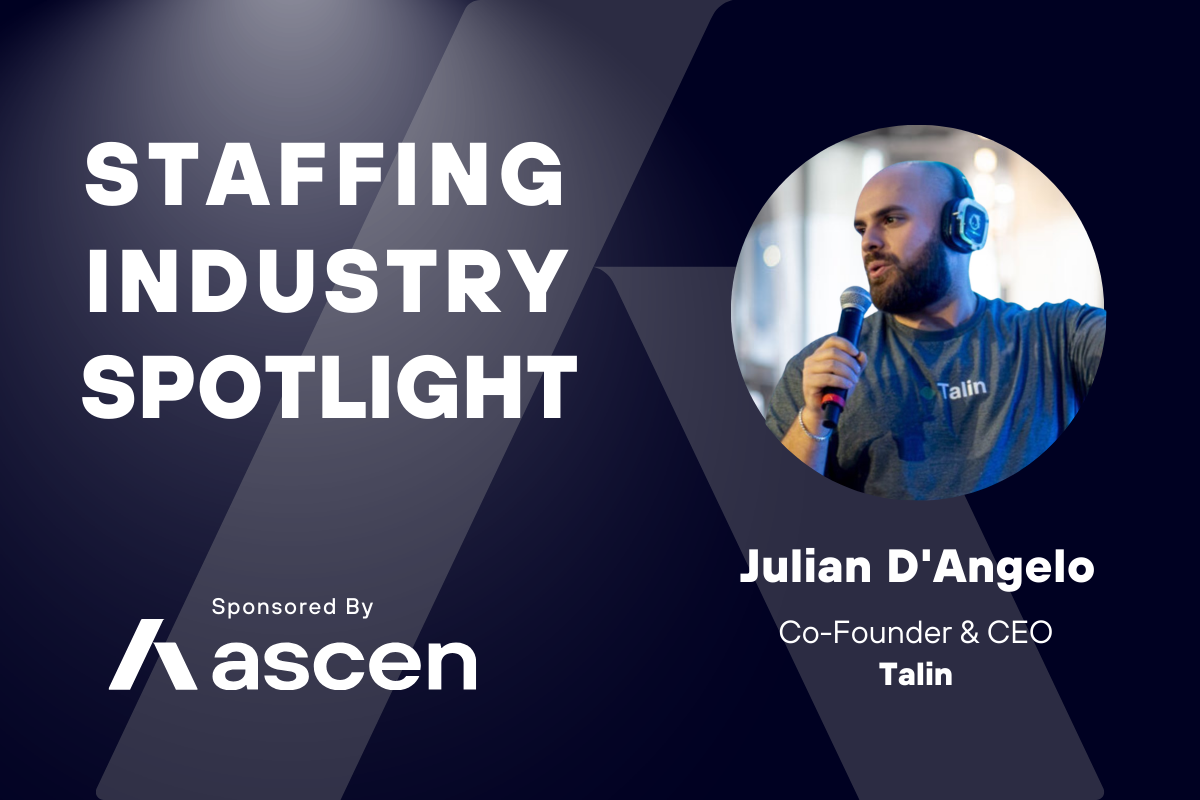
Staffing Industry Spotlight is an interview series featuring leaders shaping the staffing industry, sponsored by Ascen, a leading back-office and employer-of-record for staffing agencies. This edition features Julian D’Angelo, Co-founder of Talin, who transitioned from a career in B2B growth marketing to building AI-driven solutions for the recruitment space.
Julian shares his perspective on the "broken" tech side of staffing, comparing legacy recruitment processes to highly automated marketing systems. He discusses the evolution of agentic AI, the transition from co-pilots to fully autonomous workflows, and how staffing firms can leverage proprietary context to build a competitive moat. The conversation also explores the future of the Applicant Tracking System (ATS) and why "AI-pilled" startups are uniquely positioned to disrupt legacy firms in the coming years.
Francis Larson:
Julian, thank you so much for being on the Staffing Industry Spotlight. First, introduce yourself and what you do, and then how you got into selling AI solutions to staffing firms.
Julian D’Angelo:
My background doesn't come from staffing and recruiting at all. I spent my entire career in growth marketing, primarily for VC-backed B2B SaaS. I was at the point where I was consulting for a few companies at the seed and series A stages. Organically, they were struggling to bring on niche growth talent and asked me to help with the hiring. I suggested we do this on contingency, similar to how a permanent recruiting firm might do it. I figured out that a growth marketer's toolkit works very well in recruitment.
Within six months, I was obsessed with how broken the tech side of recruitment was. All these lightbulbs went off, and I started building Talin in my basement. Eventually, I met my co-founder, Trevor, who was an early engineer at a Canadian startup called Loopio. We've been building Talin ever since. What we first imagined has grown a lot compared to what is possible now. Now we are trying to keep up with the fact that the rulebook changes every 30 days.
Francis Larson:
So you were a marketer and realized the tools in marketing involved a lot of automation. You couldn’t even do growth marketing without it. Talk about the things you saw in marketing that are automated versus what recruiting was doing back in 2023.
Julian D’Angelo:
There are several interesting pillars. The big one is list building—simply identifying whom you'll reach out to. There is a bunch of context behind that which informs who, when, and why you are reaching out to that target. Outbound is the lifeblood of what makes a recruitment firm go. I quickly realized that recruiters were still manually doing Boolean strings on LinkedIn Recruiter. That basically sums up list building in a $750 billion industry.
Another aspect of marketing is positioning and expert-level copywriting. Recruiters often don't know how to write copy. Everyone has received a generic InMail. Now you’re seeing a jump into deep research on signals-based outreach. Tools like Clay were the pioneers; they made it actually good. Tools like Apollo and ZoomInfo had intent data that didn't work well, but Clay made it clear and accessible. Now, we are bringing that to our niche.
Francis Larson:
I’m curious about the Clay connection. People talk about Clay forever, but what does it do for marketing, and do you see Talin as "Clay for recruitment"?
Julian D’Angelo:
Clay started as a data aggregator that let you build a waterfall of data providers and connect them into one place. That became commoditized overnight; you can build it yourself in 15 minutes with Claude Code. They expanded and became a spreadsheet where every cell could be its own different function connected to any data provider. It is a blank canvas for automation-focused teams. We are not that. We do not want to be a blank canvas, because our ICP wears many hats and isn't an automation expert. Tools in our space need to be built with a predefined playbook that automates context collection and drives action. They can tweak it as they go, but we provide the intelligence. We are trying to automate GTM for recruiting.
Francis Larson:
People who do well in staffing firms are recruiters and salespeople; they aren't super technical, and they don't want to build. When do you see Talin becoming more agentic and taking over the whole journey? When does the AI totally take over that playbook?
Julian D’Angelo:
My mental model draws a line between agentic and human-in-the-loop co-pilots. If I can build something that, 95 times out of 100, the agentic output is better than anything a human could produce, even with editing, we'll make it agentic. We will say, "This is better than anything your firm will do from a BD perspective." This platform is for people who trust that. Other parts that require taste and judgment will remain human-in-the-loop. The market also has to be ready for it. I don’t know if some of our ICP would trust it yet. That is a question of when, not if.
Francis Larson:
You mentioned "taste." Rick Rubin, the founder of Def Jam, has no musical ability whatsoever—it’s all taste. Where do you see taste showing up where we can’t yet fully trust the models?
Julian D’Angelo:
In certain sub-niches within recruitment, there are nuances in how they reach out to a hiring manager and in the signals they look for. There are buttons they push that aren't widely known. That is almost IP to the individual recruiter. Even if a model is well-trained, it might not think to do what a top 1% recruiter does. Over time, as models gather more data, those instances will reduce, but right now we still see recruiters doing things we wouldn't have thought to do.
Francis Larson:
If you took that secret context and put it into Talin, would that solve it, or is it too interactive to capture that knowledge?
Julian D’Angelo:
It would solve a decent chunk of it. Outbound is a sales and marketing function. We are usually just talking about a snapshot in time. There will be a part of the market that figures out something works six months before everyone else. Eventually, everyone catches up and exploits that thing until it stops working. My vision is that the people who use Talin will have that insight before 99% of the market does. Knowing that a certain type of outreach is 50% more effective this quarter is gold. That is our intelligence layer.
Francis Larson:
Recruiters constantly find little things to exploit. You can help them identify what’s working in a way they couldn't if they were using multiple disconnected platforms.
Julian D’Angelo:
Exactly. We call it AI-generated insights. For example, we can tell you that across your 14 recruiters, these four have the highest response rate for BD campaigns, and they are specifically using MPC campaigns.
Francis Larson:
MPC is?
Julian D’Angelo:
"Most Placeable Candidate." It has about six different names, like Skilled Candidate Marketing. We are trying to standardize the jargon.
Francis Larson:
So you surface what is working and act on it. Do you see a point where you just tell the company, "This is working," and it just goes? Like Claude Code, where you can turn on "dangerously skip permissions" and it just runs?
Julian D’Angelo:
That is where we are going. However, there are trust issues in our industry with AI. Generic AI tools that don't work have ruined it for many recruiters. Because of those trust issues, I can't see recruiters hitting "accept all" right now. I’d give it 12 to 18 months before that changes.
Francis Larson:
I have a cynical view. There is a quote that scientific progress happens one funeral at a time. When people have something that works for their career, they never abandon it. They have to retire before someone new comes in and adopts a new methodology. My theory is that recruiting firms that don't adopt these tools will just die. They won't be able to compete. The new firms that are "AI-pilled" are the ones that are going to win.
Julian D’Angelo:
I agree. Proficiency with legacy SaaS tools in this industry is about 15 out of 100. It's really bad. They don't realize what is coming. I am here to provide an option that lets them keep up with the 24-year-old who has vibe-coded an AI sourcer in Claude Code without being an expert. You might see five people with the output of 50 recruiters eating up the market share in all of Boston. That's coming. You've got about two years to get on or get off.
Francis Larson:
A law firm told me that some private equity clients use AI tools to negotiate NDAs entirely without human involvement. It goes from one firm's AI to another over email, gets redlined, and goes back and forth for days until they sign.
Julian D’Angelo:
If that gets built in our space, that fills a huge gap. I think it’s technically possible, but law firms generally aren't that progressive. The idea that this is happening would give most lawyers a heart attack. You have to consider the motivation of the person telling that story.
Francis Larson:
NDAs are simple, whereas candidate outreach is complex. But it is an interesting sneak peek. When does this replace the ATS and CRM? Does that go away because Talin becomes the database?
Julian D’Angelo:
Very little of our code is written by people anymore. If we went to build an ATS right now, it would slow us down on the cutting-edge stuff we are building. An ATS is currently a commodity. Could I build one quickly? Yes. But maintaining it would cost too much in terms of focus.
Francis Larson:
What's the point of an ATS if people aren't doing the manual outreach anymore?
Julian D’Angelo:
It becomes a Kanban for the hiring pipeline. You still need confirmation, but it could happen programmatically.
Francis Larson:
Your "open call" instance could just say, "You made a million bucks. Congrats. It's been deposited into your Swiss bank account."
Julian D’Angelo:
If we crack the "walled garden" for booking meetings with hiring managers better than anything else in existence, that concept is worth billions. The candidate side is well-defined, but the BD side is a total mess. Tactics aren't formalized. Recruiters don't share what works because they are competing with their own team. We are building the primary data set for what works.
Francis Larson:
Will you add scheduling and interviewing?
Julian D’Angelo:
Nobody has "won" on that yet; it’s still very fragmented. I think it’s a commodity, so we’ll wait and see if Gemini or OpenAI releases a tool for it. I don't like building commodities. I want to build the difficult stuff that competitors won't figure out.
Francis Larson:
The world is moving so fast. I thought it was slowing down, then I read "Situational Awareness" and went deep into AI. It advanced, plateaued, then Opus and Sonnet 3.5 came out, and it was a step change again. How do you build a moat when people can build so quickly?
Julian D’Angelo:
That path is identical for me. I thought it plateaued, and then the game got rewritten. Mental health takes a toll because you're in a doom loop of "This is incredible" to "Someone could vibe-code my tool in a weekend." Your moat is providing context that the weighted models and publicly available data can't. As more people use Talin, it gets better and has intelligence that the market doesn't. We are running proprietary experiments. That is the litmus test. It's a moving target; a product you build today will be outdated in eight months. That is the world we live in.
Francis Larson:
Peter Thiel's "Zero to One" mentions that it is important to have secrets—secret insights. That secret knowledge and context is what Talin has. Julian, it’s been great to chat. I think about this constantly, so we could go on for hours.
Julian D’Angelo:
Ditto, man.


.png)