Staffing Industry Spotlight: Brad Bialy
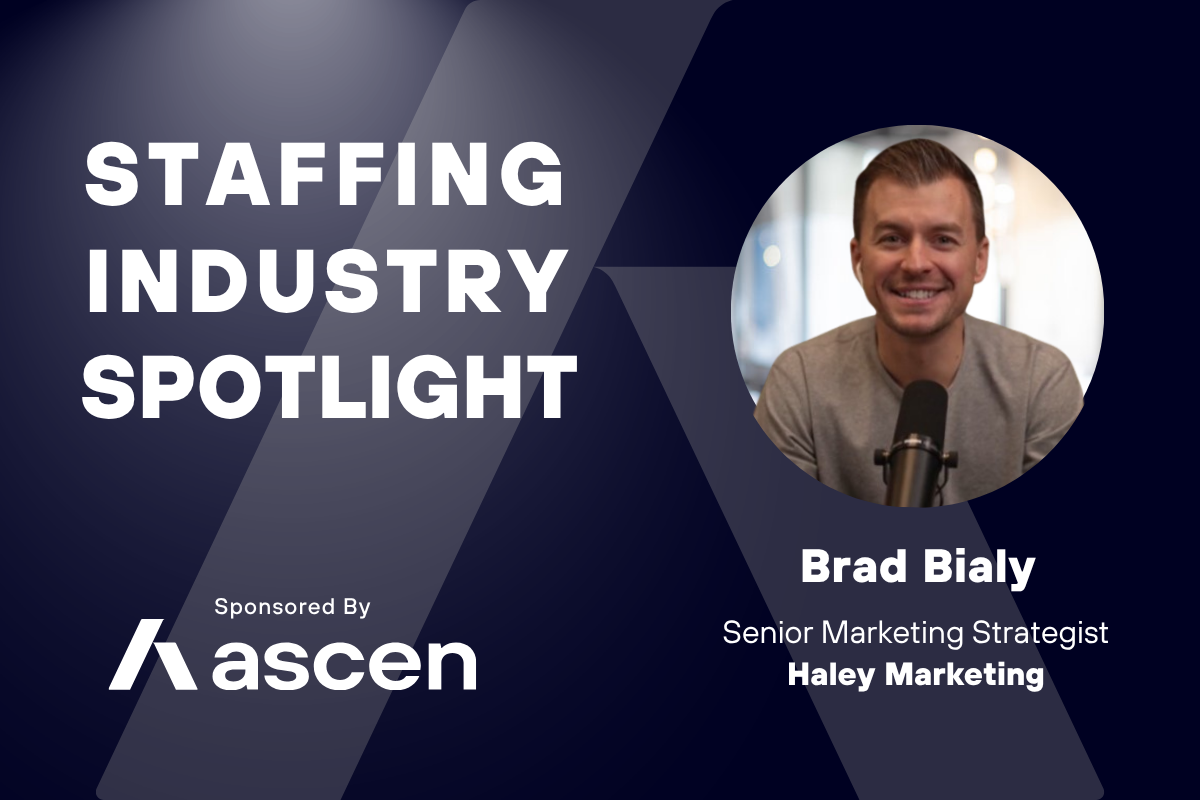
Staffing Industry Spotlight is an interview series featuring leaders shaping the staffing industry, sponsored by Ascen, a leading back-office and employer-of-record for staffing agencies. This edition highlights Brad Bialy, who leads the marketing team at Haley Marketing and brings 13 years of specialized experience to the conversation.
Brad shares insights on how top-performing staffing firms successfully marry their sales and marketing systems to achieve the 70+ brand touchpoints required to build true awareness. He also discusses the tactical evolution of modern channels, explaining how traditional SEO is expanding into AI and Answer Engine Optimization (AEO), how firms can effortlessly turn sales call transcripts into unique "one of zero" content, and why maintaining a strict niche focus is essential for long-term growth.
Francis Larson:
Brad, thanks for being on the staffing industry spotlight. First, we’d like to know how you got into the staffing market and marketing for staffing companies.
Brad Bialy:
Good timing. Yesterday was my 13th anniversary at Haley Marketing, so I’ve been here for 13 years now. When you ask how I got into staffing, I think I got in the same way as everyone else: I just stumbled into it. What happened—fun story—I was still at Brockport, where I went to college, and a friend of a friend reached out and basically said, "My company’s hiring. Do you know anybody in marketing?" That made it to me, and I interviewed with Brad Smith, who is still our Chief Strategy Officer, and the rest is history.
When I started, I was working Fridays and Mondays. I went to school about an hour away from where the office was at the time. I was driving an hour each way to work on Fridays and Mondays because I didn't have class then. When I graduated, they just brought me on full-time, and I've been here since. So, 13 years and a day at this point.
Francis Larson:
And was this your first job?
Brad Bialy:
It was my first job out of school. I did quite a bit—I've done some things on the side, too, in professional lacrosse and professional sports—but this is my first and only full-time job outside of graduation.
I worked for the Rochester Rattlers for Major League Lacrosse. When that league folded and went to the PLL, I moved indoors for the Rochester Nighthawks. Then, for about five years, I actually worked for the National Lacrosse League as their social producer. For about five seasons, anything that went out across Instagram, Twitter, or Facebook on game night, there was a good chance it came from me in my home office. It was fun.
Francis Larson:
How did you get into lacrosse? Were you familiar with it, or was it by chance?
Brad Bialy:
In the same way I got into Haley, I met the right person, and they got me involved. When I started at Haley, Kyle Denhof, who is now at HubSpot, was one of our social media advisors. He played for the Rochester Rattlers. At that time, that team had no marketing support. They had a really good graphic designer in Charlie Ragusa, but he was their game-day coordinator, helping with equipment—equipment-manager-type work. Kyle basically put me in contact with one of the owners of the team and said, "This guy's good. He's talented. Let's give him a shot." I got to Haley because of who I knew, I got to the NLL and professional lacrosse because of who I knew, and the rest just fell into place.
Francis Larson:
So, for 13 years, you've been helping staffing companies do marketing. You’re leading the marketing team at Haley. How has it evolved? What was working when you started, and how did it change over time?
Brad Bialy:
I think what worked then is still what works now: knowing your target audience and delivering the right message to them at the right time, using what we call the AIDA model: Awareness, Interest, Desire, Action. Funneling people through that model is advertising 101. I can't get you to do anything before I first have your attention. Before you know who I am and I'm in your world, I can't get you to take any sort of action.
In terms of what was working tactically 13 years ago, you could have a better impact with Facebook organic posts. You could have a greater impact on email open rates. Maybe you could have a better impact with strictly blogging as an SEO play. Now we know the tactics have changed, but it always comes back to what we've been doing for hundreds of years: getting awareness, interest, and desire, and getting people to take action. It’s the same method; it’s just the tactics and the methodologies of how you're wrapping it that change.
Francis Larson:
Have the channels changed, too? Did it go from email and Facebook to something else?
Brad Bialy:
Right now, AI is on everyone's mind, and how we can influence LLMs. I must have a conversation a day about how to get a staffing firm to show up in ChatGPT. That's the conversational buzz right now. But yes, when I started 13 years ago, it was: "How do I make an impact on Facebook?" Right now, we know 1 to 3% of your Facebook audience sees a post. You need to be posting on social, but the impact of it is different.
It’s very much just keeping your ear as low to the ground as possible, having the courage to stay in a lane that is working, and even having the courage to punt what is not. Just because it worked in the past doesn't mean we have to keep doing it.
Francis Larson:
What's working today? What are the core channels for staffing firms? I see firms that struggle often lack focus on who their buyer is or what type of staffing they're doing. Can you talk about what's working today for firms that are crushing it?
Brad Bialy:
We know it takes 70+ touches for someone to fundamentally know you exist. Whether you're selling t-shirts or staffing services, it takes over 70 touches just for someone to know Brad's Widget Company is on this planet. That's not to get the order or the conversation; it’s just awareness.
The best staffing and recruiting firms are marrying their sales and marketing systems to give their brand more at-bats with the right buyers. The average sales system is a 10-step process—email, phone call, maybe some print collateral—and that's fine. We also know that 90% of sales reps give up at the fourth attempt. We’re human; we get distracted or bored. If I’m prospecting with you and you aren't getting back to me, I move to somebody else because I don't like to hear "no" or, worse, nothing at all.
Mathematically, if it takes 70+ touches to know you exist and people give up at the fourth attempt, it’s a numbers game. You aren't getting the conversation because of raw mathematics. The best firms are layering in marketing automation, email automation, pay-per-click advertising, search engine optimization, or physical direct mail. Whatever the tactic, they're getting more at-bats in front of the right people to get closer to that 70 number without annoying the audience. When that audience has a need, they know who to call. People aren't buying staffing services every day, but when they are, they need to know your firm or mine.
Francis Larson:
Should every staffing firm be doing all of these channels, or do some work better for certain firms?
Brad Bialy:
Most firms are not doing all of it as a byproduct of the industry. Typically, staffing marketing budgets are smaller, so they can't do everything. In a best-case scenario, you want to surround your potential buyers and live in their world. It’s no different than consumer goods. You don't buy from a direct-to-consumer clothing company daily, but you get emails, text messages, and social ads so that when you need a new t-shirt, you know where to go. The best staffing firms are borrowing from that playbook. Most will only use one or two tactics and try to duct-tape them together. The best are looking at what’s working and expanding on it rather than necessarily replacing it.
Francis Larson:
Let’s talk about the AI channel. Do you think AI optimization is different from SEO?
Brad Bialy:
No, I really don't. I was on another show a month or two ago and said that AIO and AEO (Answer Engine Optimization) are just extensions of SEO. LLMs are scraping the internet and "ad-libbing" answers based on compounded information. The only way to get into an LLM is to have put together content clusters, topical authority, or relevance around a topic.
For example, I realized ChatGPT will show videos in answers if you ask. I was looking for a recipe and asked to see it as a video, and it worked. So, I asked ChatGPT for a video on a concept we created called "The Invisible Guest Theory." I know our video ranks well for it, and ChatGPT served it to me. The only way it knows that's the best video is because I created it, built content around it, and told YouTube and our website that we are affiliated with that term.
You only get into LLMs if your site is structured to provide the content and relevance they need. It’s not different; it’s leaning into best practices—blog articles, content, FAQs, and robust websites. That’s feeding the machine.
Francis Larson:
Some LLMs rely heavily on review sites, Reddit, and social. Are you seeing staffing agencies doing anything on those sites?
Brad Bialy:
I've always loved Reddit for staffing firms. The challenge is that you need to be a part of the community. Reddit users quickly sniff out self-promotion. If you’re a staffing firm in Buffalo, New York, it’s beneficial to join a Buffalo subreddit. Comment on what’s going on this weekend or add value to local events. When you can sprinkle in "by the way, we have these jobs available" after you've added value, it works. But if you just go in and self-promote, it's the quickest community to punt you. You have to be a member of the community first.
Francis Larson:
What kind of content do staffing agencies need to produce? Do you have concrete examples of what they should be doing?
Brad Bialy:
I’ll give you a framework. We want to create the best possible answer to any question that might be asked online. Google and LLMs exist to give the best answer. Alex Hormozi refers to "one of zero" content—an article you can create that zero other people can create.
In staffing, instead of writing "Seven Ways to Improve Your Resume,"—which any firm can create—structure it as: "From my shoes, having been in staffing for 13 years, these are the seven things that stop me in my tracks and elevate a candidate to the top of the stack." Now you have "one of zero" content. No one else can create that because it lives in your brain. It's still resume tips, but it's structured so that people want to read it for your specific experience.
Staffing firms have so much data; they can easily create this content. They just need the courage to sit down and do it or partner with someone who can help.
Francis Larson:
Where is that content coming from? If you’re a small company, you don't have time to write blog articles. How do you do it consistently?
Brad Bialy:
One: Partner with a company like Haley Marketing or find the right tool to run alongside you. Two: Lean into what you can commit to. I used to call it the "social media workout program." If you want to post three days a week, that’s your gym schedule. If you can only write one article a month, commit to that.
I love to talk. I run a podcast, and we’ve put out a weekly episode for seven years. I’m good at conceptualizing on the fly, but I don't like to write. If I had to write one article a week, it would never get done. However, I can interview three people a week and easily come up with content.
Another piece of low-hanging fruit: Lean into the assets you already have. Your recruiters and sales reps are on calls all day. Take a transcript, put it into ChatGPT or Claude, and ask for five pain points it mentions that might work well for your audience. You can prime the AI with your ICP (Ideal Customer Profile) so it knows what they should be worried about. Have the AI write rough drafts from your transcripts that you can then revise. I had seven calls today; there’s great content from those conversations that I’ve already shared with clients. Leverage what you're already doing. Don’t reinvent the wheel.
Francis Larson:
The transcript thing from sales calls is so good because you're doing it anyway, and they are literally telling you what they want to search for.
Brad Bialy:
Exactly. You want to blog about pain points your prospects have? You just had seven calls talking about them. Turn that into a white paper, blog articles, or a social series. That is the easiest place to start because you’re already dictating the article. Now it’s just a matter of getting an LLM to help structure it.
Francis Larson:
Are customers giving you access to their Gong transcripts so you guys can figure it out?
Brad Bialy:
We’re starting to go down that path with Rogue IQ, one of our new tools. We can create blog articles, social content, and SEO pages by feeding it reference samples and transcripts.
Francis Larson:
That’s cool. So, beyond content, what are you seeing working in paid channels? Paid search for staffing services seems hard.
Brad Bialy:
From the sales side, I love leaning into the sales system. Say you’re using a tool like Apollo or Lemlist to deploy a campaign to a couple thousand people. Your team is calling and emailing. Let’s also serve those same people ads across LinkedIn, Facebook, and Google’s advertising network. Now we’re touching them 10 times through sales and another 10 through PPC.
We can also look at keyword buys. If you want to outrank your competition, the easiest way—though not the most affordable—is to buy their name as a keyword. You see this in luxury cars: Audi will buy the BMW keyword to show up ahead of them. You can do that in staffing.
Francis Larson:
To double-click on that: if you buy a competitor's keyword, do you need relevant content for Google to show it, or can you just bid?
Brad Bialy:
It could lead to an article like "What the Top Five Staffing Firms in Buffalo Do Well." You aren't slandering anyone, but it's on your site, and you’re controlling the message. That is a great piece of content that favors you in a different way.
Francis Larson:
LinkedIn ads seem to be something people are doing more of.
Brad Bialy:
They work very well. The challenge for many firms is budget; LinkedIn is higher cost than Google or Facebook. But if you want to reach the decision-maker at a specific company, you can easily do it because they have a profile. You’re going to pay for it, but if you want meaningful conversations, you need to raise awareness first. If they don't know who you are, they’re never going to return your email.
Francis Larson:
Do you track the cost of customer acquisition (CAC)? How much should a mid-market staffing firm pay per customer?
Brad Bialy:
I wish I had that data, but I don't. If I did, I could go to clients and say, "The number is X, and you’re 4x below that." We do know that individuals doing over three programs with us see better success than those doing two or fewer, which comes back to having more at-bats.
Francis Larson:
In tech, we track CAC religiously. If you're making $100,000 in net fees from a customer over three years, you might spend $20,000 to $25,000 on sales and marketing to get them. I don't think staffing owners think like this.
Brad Bialy:
I don't think they're getting that refined, and I wish they were. I harp on that 70-touch number at conferences because it speaks to the value of repetition. Consumer brands like Lululemon are in your inbox every other day for a reason. Buyers have options; I can go to Target for pants or spend $150 at Lulu. Staffing firms need to understand that better.
Francis Larson:
If someone increases their touch points and starts doing all the channels—email, blogs, SEO, paid search—how much of their revenue should they be spending on marketing?
Brad Bialy:
In staffing, I think it’s often less than 1%, maybe 0.5%. I think it should be at least double that. It’s all relative to what you’re willing to invest. Marketing is an investment, not an expense. It becomes an expense only when you can't see the result. If I cut a $1,000 check and it generates $5,000, I’ll do that every month. The reason marketing becomes disconnected is either we aren't connecting the dots well for clients—though we're getting better at that—or owners just see it as a bill to pay.
Francis Larson:
It’s probably because staffing owners often come from sales and see it as a sales game rather than a marketing game.
Brad Bialy:
100%. I was talking to a client who decided not to invest in marketing because they hired two new sales reps instead. That’s fine, but your sales team needs air cover. A sales rep isn't going to call someone 70 times—if they do, that person will run for the hills. Marketing supports the sales system so the team has leads to call.
Francis Larson:
You used the word "air cover." I just finished a book on war strategy that says tanks are easy to blow up without infantry support. The tank is like a salesperson; if it’s all alone, it won’t work. Are you seeing any staffing agencies going fully inbound?
Brad Bialy:
Not fully inbound, but I think it’s coming with the rise of AI. AI agents—voice or digital—are becoming very interesting. I don't know of any firms that are 100% inbound yet. It’s still a people-first business. We know roughly 61% of people prefer a rep-free buying experience until the final stage, where they want to talk to a human to reaffirm their beliefs. There will always be a salesperson to close the deal, but marketing integration can certainly generate more inbound leads.
Francis Larson:
People are worried about "AI slop" in marketing. How do you prevent that in emails and blogs?
Brad Bialy:
AI slop is just bad inputs. Garbage in, garbage out. The better you are with your prompts, the better the output. We’ve built software that produces next-to-zero AI slop because of how it’s primed. If you just say, "Write me an article on resume tips," you’ll get generic content.
If you coach the AI on who it is, where to pull research from, and provide transcripts of your own talking points, the quality changes. With Rogue IQ, we use a multi-LLM approach: it might be written in ChatGPT, scored in Gemini, and then rewritten in Claude. You will always get slop if you put in bad inputs. It’s like drawing a picture; if I give you one minute to draw a unicorn, it looks one way. If I give you unlimited time and detail, it looks completely different.
Francis Larson:
Giving it authentic content and using a framework is key.
The best staffing firms we work with have a defined niche and a clear ICP. How often are you advising companies to clarify their strategy?
Brad Bialy:
We talk about it at the start of every project. Almost every firm wants to sell to any potential buyer. If you're great at placing welders, you have no business trying to get orders from healthcare providers. Stay in your lane and own it. When you try to be all things to everyone, you become nothing to anybody.
The firms that are failing are the ones still using "better, faster, stronger" messaging. Buyers don’t care about that; they care about their own pain and how you can alleviate it. We just need the courage to ask, "Who are we actually speaking to?"
Francis Larson:
People are often surprised by how big the market is within a narrow focus. You can do school nurses in one state or meat manufacturing in one region and still get huge.
Brad Bialy:
The more you own that slice of the pie, the better. We’ve said that forever. Before you think about different niches, own your slice. Keep the blinders on until you do. There is so much business to be won in what you and your team are already good at.
Francis Larson:
Brad, this is really good advice. Thank you for sharing your insights.
Brad Bialy:
Thanks for having me on. I appreciate you.