Staffing Industry Spotlight: Rihab Lajmi
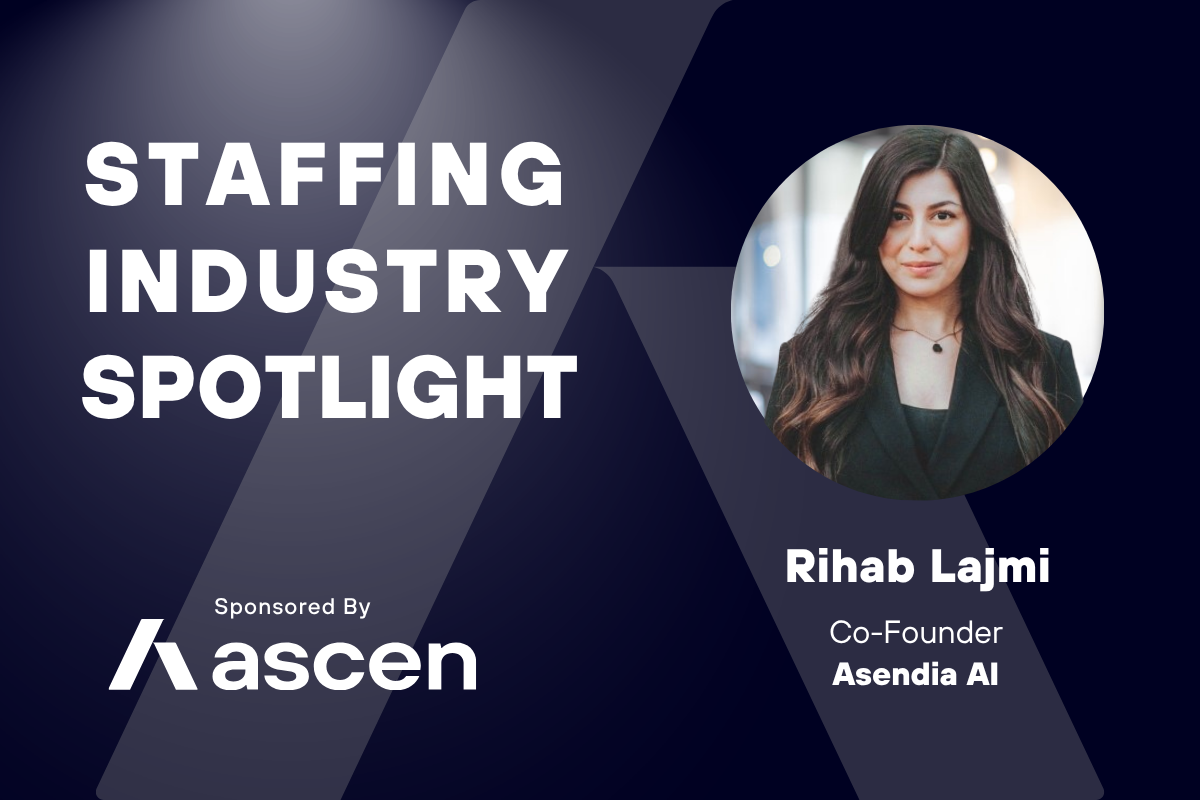
Staffing Industry Spotlight is an interview series featuring leaders shaping the staffing industry, sponsored by Ascen, a leading all-in-one Employer of Record for staffing companies.
This edition features Rihab Lajmi, Co-Founder of Asendia AI, who leverages her background as an engineer at Microsoft and Google to tackle the "business problem" of inefficient hiring. Rihab discusses the rise of agentic AI platforms that live on top of existing ATS systems to "clone" a firm's best recruiters by automating repetitive outreach and initial interviews. The conversation explores the critical need for industry-specific AI solutions over generic models, the power of real-time multilingual candidate engagement, and why the human element remains an irreplaceable component of high-value recruitment.
Francis Larson:
Thanks for being on the Staffing Industry Spotlight. I’d love to know how you got into this? You said you joined Y Combinator (YC) and were at a bit of a later stage, but I am curious about your journey into the staffing industry versus all the other things you could be doing.
Rihab Lajmi:
That is a really good question that I ask myself often. For me, it was a fun story. Before this, I worked in the cloud computing space. I am an engineer who studied physics and engineering, and I am very passionate about building products. I worked at companies like Microsoft and Google. If you are familiar with how hiring in big tech companies works, they usually have someone from the team oversee or be involved in the hiring process. That was my initial interaction with how big companies hire. It struck me then that this could be done so much better. I was sure that in enterprise or large companies, it was a much more painful process.
I started thinking about this with my co-founder, who is also my partner. He is an engineer in the AI space. We talk about a million different ideas every day, and it turns out this was a pain he had in his past role as well while hiring for his technical team. We started exploring until we came across staffing. We went to every single event related to hiring, whether it was for startups or big companies, until we found staffing and started talking to staffing leaders a couple of years back. That was the "aha" moment for us. We realized this industry doesn't just have a hiring problem; it has a huge business problem. As we explored, we fell in love with that problem and thought we could be the best people to solve it.
Francis Larson:
Was your partner at Google as well?
Rihab Lajmi:
No, he was working at Infineon Technologies. It is a big semiconductor company in Germany and Europe. We moved from Germany to the U.S. a little over a year ago.
Francis Larson:
Was that move in order to do YC?
Rihab Lajmi:
YC actually came in later. We just got into YC about a month and a half ago. We moved here while we were building our product because we wanted to be close to our customers. That was the best decision for us.
Francis Larson:
I imagine being around that is helpful. In staffing, unlike tech, it is all around the U.S. Some of the biggest customers are everywhere. How has being in San Francisco affected you versus being somewhere else? Is it just the benefit of being around the cutting-edge AI stuff?
Rihab Lajmi:
Absolutely. San Francisco is the most vibrant tech hub we have been to. There are some amazing places in Europe, like Germany, Sweden.. and we have worked with many people there, but what we have seen here in San Francisco is completely different. As we grow our team and open our office here, the quality of people is just amazing. We are trying to have the best of both worlds where we have people from staffing, but also amazing people from the product side who bring a fresh perspective. We have seen that add a huge value for our current customers. Having an outsider's perspective on traditional ways of hiring and manual processes provides feedback we can’t find anywhere else. That combination is working like magic.
Francis Larson:
I totally agree with that. We also came from outside the staffing industry, so the way we thought about it was more tech-based. We hadn't been exposed to the software and the problems, so we thought about it very differently. Anyone coming into the industry with a product-tech mindset can approach problems in a much simpler way.
Going back to what you said about the staffing industry, you started out going to all the hiring events. We will get into what the product actually does in a second, but what about the way staffing and recruiting companies use Asendia is different? Or is it just that they have more demand?
Rihab Lajmi:
It is actually a bit of both. The demand is really high on the staffing side because it is a business problem. This is a pain point they need a solution for every single day. Because their teams are doing everything manually and repetitively, they are looking for ways to grow their revenue without the need to hire 20 or 30 more recruiters. That is expensive, and they need to run their business in a much smarter, data-driven way. Naturally, there is a lot of demand. The majority of our customers actually came to us; we didn't have to try to bring them in.
The other piece is the difference in how recruiters work in a staffing company versus an enterprise company hiring for its own team. Staffing companies get requisitions from their clients and have a reputation and certain standards to keep regarding the candidate profiles they deliver. It is the entire facade of their business. In verticals like healthcare, staffing companies are competing over certain requisitions, and the fastest one to find the best candidates wins that project. That crucial aspect of a solution like ours is what drives us every day. It allows us to see the impact in a much faster and more powerful way. We had our quarterly call with one of our customers a couple of days ago; they doubled the number of placements they do with Asendia in just three months. As soon as they scale this across every job they have, they are on the way to doubling their revenue using our platform.
Francis Larson:
The speed factor makes a ton of sense, especially for people dealing with enterprise or anything commercial. If they are working through a VMS where they get a requisition and have to be the first to provide a quality candidate, that makes sense. Even in the mid-market where it isn't tracked, speed still matters subjectively.
Let's go into the actual product. What is Asendia doing? There are a lot of AI recruitment products out there. What are the core Asendia features?
Rihab Lajmi:
When we started with the idea a couple of years ago, we even discussed the real-time voice AI interview experience before it was released by OpenAI. We knew this was going to have huge potential. However, Asendia is not a point solution. We are not just a voice AI interviewer or a voice AI recruiter. Asendia is an entire agentic platform that lives on top of your ATS. It is all data-driven. The way we do things differently is summed up by our motto: "Clone your best recruiter with Asendia AI."
We have a system that connects to the company's ATS. It analyzes what has been working and what hasn't. And then the agent gets to work. It is a combination of the voice AI interview, SMS features, and WhatsApp features, but it is all part of an entire intelligence platform driven by data. I believe we are the only platform where our system actually improves automatically over time. It ingests data and gets better at outreach. Our customers love that because they feel like they are shaping the future of their companies with us. They refer to us as a technology partner rather than just an AI solution.
Francis Larson:
In a way, you are doing the AI transformation for them. Regarding the ATS, it can be very difficult because there are a lot of niche staffing integrations. How has that gone with staffing-specific systems like Bullhorn?
Rihab Lajmi:
Obviously, the bigger the ATS, the easier the API documentation and integration process. But we do have a good number of customers who have proprietary ATS systems. For those, they generally have a team capable of helping us through the integration. Our engineering team is amazing at making it easy to integrate with these customers. The speed of integration is something our customers really love because they can almost immediately start getting a taste of what the platform looks like. We also have a standalone platform for companies that don't have an ATS or are still figuring out how to integrate it with Asendia. It is a fully functional platform with amazing features they can use to connect with their data and signals.
Francis Larson:
What happens on that UI? Is it a funnel of candidates? If I don't have an ATS and I work with Asendia, how do I start working with it in your UI?
Rihab Lajmi:
The first step would be to customize your workflows. What workflows are you looking to launch? Before we have the integration, the agents won't be able to capture data automatically, so the recruiters would be building their own workflows, choosing the channels, and setting the messaging. They also customize their AI recruiter, where you can configure every single aspect of the AI interview experience your candidates will have. Then, there is an intelligence layer where you get to see the outcome from every workflow launched.
Francis Larson:
Are you doing the initial outreach for candidates? If someone identifies a job description, are you actually reaching out to schedule interviews?
Rihab Lajmi:
Yes. There are two very popular use cases. The first is having an AI agent scan your entire database for matching candidates and looking for any inbound candidate who applies. Any requisition you get from a client, the agent will look at your database and be on standby for every applicant. Then it will do the outreach, which is a combination of AI phone calls, video calls, WhatsApp, and SMS. It will adapt based on the nature of the role and the candidate. After the AI interview is successfully done, an in depth assessment is sent back into your ATS for the recruiter to review.
Francis Larson:
So it is reliant on the ATS getting the candidates in the door? You aren't going out to post a job on LinkedIn or anything like that?
Rihab Lajmi:
We do have an external sourcing component called the "AI Sourcer." it goes beyond your existing database to our own proprietary database. It will find the best candidates who are a fit, import them into your ATS, and then initiate an outreach.
Francis Larson:
We have an internal theory that very soon there will be really large agencies built on only a couple of people. They can have everything else on the recruiting side fully automated—getting the job in, posting it, finding candidates, reaching out, and doing interviews before submitting to the client. How far away are we from that vision where a staffing agency effectively becomes a sales agency and the fulfillment is handled by something like Asendia?
Rihab Lajmi:
I would say the top of the funnel is already being 100% done by AI agents, workflows, and automations. However, my personal opinion is that the human aspect will not go away. We see this with our current customers. We look at this technology as something that empowers staffing companies to do their work faster and more efficiently, but that human aspect remains. You can have the AI agent submit final candidates to the client, but that final interaction they have with a human recruiter—someone they trust and have a relationship with—is something that makes staffing companies unique and special. I don't see that going away. Even if agents can submit the best 10 or 20 candidates for a role, that final interaction with the recruiter is essential.
Francis Larson:
I wonder if that is industry-specific. In pure gig work, we don't see that. The platforms tend to not have a lot of interaction with candidates; they are just matched and automated. But the higher you go up in pay scale, the more important the human interaction becomes. Do you think Asendia will ever migrate to more client-side stuff, like demand gen or dealing with the client, or will you stay on the recruiting side?
Rihab Lajmi:
We are seeing so much added value and success within the staffing industry that we plan to stay here for a while. This is where we have been able to iterate the fastest on our product.
Francis Larson:
Are you worried about companies like Claude or OpenAI doing this kind of thing? Bigger AI companies are starting to get into application-based areas. How do you stay on top of that?
Rihab Lajmi:
I think it's the same way we look at any other AI recruiting platform. When you are trying to sell to everyone, you are not going to create a perfect product for a specific industry. It is hard to build a product that is perfect for staffing when you are also selling to talent acquisition teams, restaurants, startups, and more. You can have the best technical team in the world, but if your product is very generic, it won't cater to everyone’s specific needs.
Staffing has very specific needs, like that speed factor we discussed. Even within staffing, you have healthcare, IT, and light industry. Although the structure is somewhat similar, the way they hire, the types of candidates, and their recruitment cycles are all different. It is important to work closely with the industry to build something that really solves their pain. That is why we aren't expanding too broadly from day one. Try to find a partner who has worked with similar companies and can describe the pain they solved. If they can’t do that, they probably have a more generic horizontal solution that might not be the best partner for you.
Francis Larson:
What is next for Asendia? You have the sourcing, the interviewing, the scheduling, and the shortlisting. What is on the horizon?
Rihab Lajmi:
There are many things we will be launching in the next few months. In the short term, providing a multilingual agent that is capable of adapting to the candidate is something that resonates a lot. No matter what language the candidate speaks, the AI will be able to adapt in real time. We have seen great success with that; the candidate doesn't get frustrated if they don't speak English. We have customers running Asendia in over 45 countries and operating in over 10 languages.
Francis Larson:
Do you have API access yet?
Rihab Lajmi:
Not yet, but you will see more about that in the next few months.
Francis Larson:
What is one last piece of advice you have for recruitment and staffing executives on how they can learn about AI in recruitment and get up to speed?
Rihab Lajmi:
First, subscribe to our newsletter. We recently launched a monthly physical newsletter that we send to offices. It covers the trends of the month with AI in staffing and some of the agents our team has built. Second, talk to as many staffing agencies and AI companies as you can. The more conversations you have, the better you understand common pain points and what platforms are solving them.
The most important advice is to look at your team and see the workflows that aren't working. A lot of companies feel pressure to use AI because everyone is talking about it, but they end up picking the wrong tool because they are overwhelmed. Sit down with your team, see what your recruiters are spending the majority of their time on, and identify what is and isn't working. That way, you will truly understand what will work for you. Stay up to date with content on LinkedIn as well. We are trying to post good content there, and I am always happy to help if anyone wants to have a chat.
Francis Larson:
Very generous. It's been lots of fun talking about AI in the staffing space. Thanks for having a conversation.
Rihab Lajmi:
Thank you, Francis. Thanks for having me.





.png)