Staffing Industry Spotlight: Steve Malley
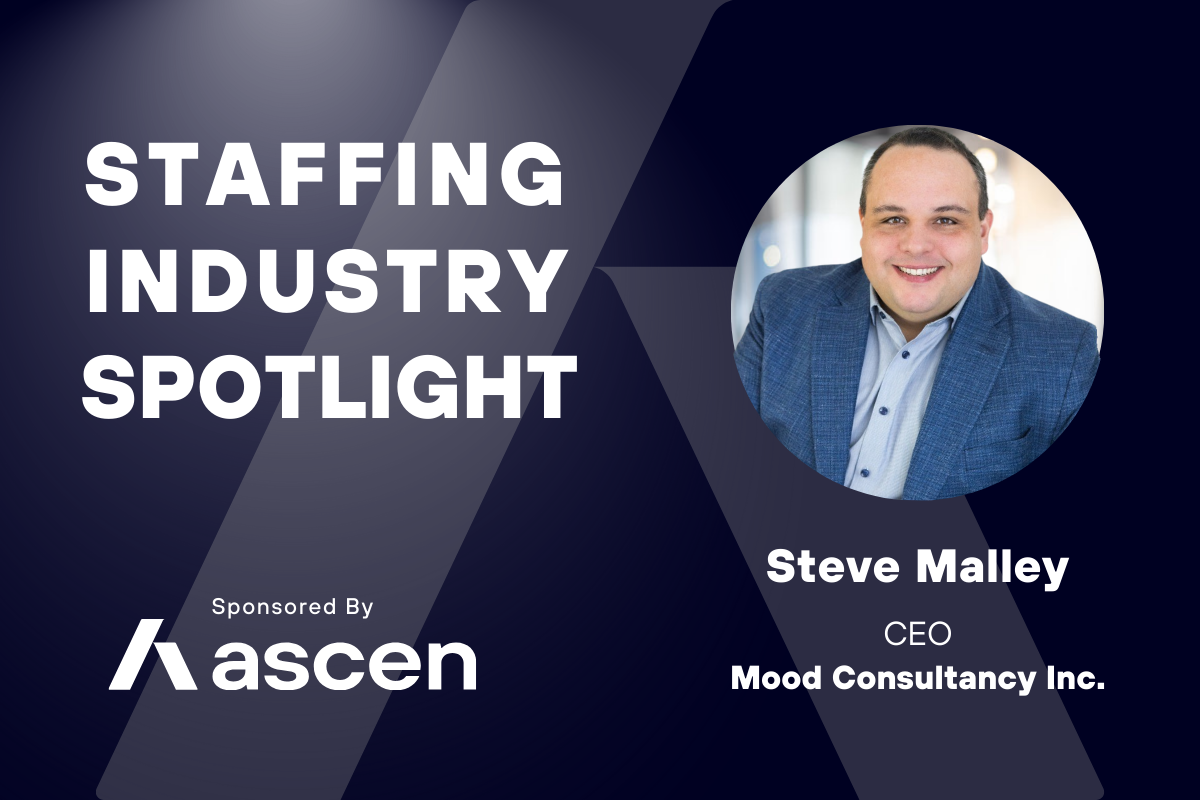
In this installment of Staffing Industry Spotlight (sponsored by Ascen, a leading back-office and employer-of-record for staffing agencies), we sit down with Steve Malley, CEO of Mood Consulting Inc., who brings two decades of expertise in the payroll, PEO, and HCM sectors to the table. Steve shares a fascinating look at the evolution of the global Employer of Record (EOR) space—from its early "GEO" days to the modern era of multi-service platforms. The discussion dives into the current wave of industry consolidation, the need to create a defensible "value wedge" to differentiate in a crowded market, and how AI is drastically reducing service costs while finally giving HR a strategic seat at the executive table. Whether you are curious about the future of talent sourcing or looking to master the "3D chess" of hyper-synergistic partnerships, Steve’s insights offer a valuable roadmap for navigating the rapidly changing human capital landscape.
Francis Larson:
Steve, thank you so much for being on the Staffing Industry Spotlight. First, we'd like to know who you are and what you do.
Steve Malley:
Great to be on the spotlight, thanks for having me. I'm Steve Malley, the CEO of Mood Consulting Inc. It’s a global market entry and growth strategy company based in Rochester, New York, that I recently relaunched. We help companies optimize their workflows, find synergistic revenue opportunities, and lead them through M&A processes. I'm leaning on over 10 years of experience in the global EOR space and the majority of my 20-year career in the broader payroll, PEO, and HCM space.
Francis Larson:
You've been in the EOR space since before it was popular. I believe you started in the PEO space before that. I'm curious how you've seen that market evolve over time.
Steve Malley:
It’s synergistic with the way the world is going with platforms trying to be "everything" based—platforms that can do EOR, PEO, payroll, recruitment, and staffing. I think the employee’s journey is the catalyst for that. Anything that can support an end client’s optimization of the employee lifecycle or wellness drives decision-making around adding service lines.
We have seen significant disruption across the industry for the last five to ten years; it feels like every two years, there is a new disruptor. If you have a large workforce, there is probably an adjacency service they need. We are seeing companies build platforms so consumers don't have to go to 10 different companies and rely on APIs or webhooks to pay their most valuable asset: their people. The pandemic proved that we can work well together remotely, leading more companies to explore global work.
The Rise of the Employer of Record (EOR)
Francis Larson:
You were involved in EOR back with Safeguard years ago. It was called GEO then—it wasn't even called EOR at that point.
Steve Malley:
You still have people calling EOR "International PEO," which is categorically flawed because there is no co-employment in countries like France. What happened is some big companies came in and marketed the heck out of "Employer of Record."
Little-known fact: if you put #EOR on a LinkedIn post five years ago, it went to something related to oil and gas. It had nothing to do with human capital. But when you see the amount of money pumped into this industry from VCs, they used that money to teach the world what Employer of Record is and make it mainstream. "GEO," as cool a name as it is, has been unintentionally phased out by the true solution, which is Employer of Record. That is what we should be marketing, not something that makes it hard for people to understand.
Francis Larson:
Since COVID, there's been an explosion of players in the space. How do you think that's going to play out? You can't have a thousand EOR providers.
Steve Malley:
We're already seeing consolidation as a major trend. You don't have to look far to see companies acquiring and adding service lines. Consolidation will remain the major trend for the rest of this year and beyond.
It boils down to "value wedge" creation. A value wedge is something you do that is defensibly different and better than the competition. Saying you have the most country coverage is not a value wedge. Saying you have in-country compliance across your 100-plus entities might be defensible. It also has to matter to the client; you can say you're the fastest or most compliant, but it doesn't matter if you can't defend it with facts.
Prior to my current role, I launched Vensure Global. They have hundreds of thousands of clients who are likely doing business elsewhere, so technology consolidation creates a value wedge. We're seeing the industry tier out into top providers and others that may provide only one strong lane, such as global payroll or contractor management. My hypothesis is that companies don't want to engage with 10 different providers to address their contingent workforce management needs. If you can go to one provider for contractors, EOR, and your 200 workers in the U.S., that is where you see the "everything platforms" separate from the pack.
Francis Larson:
Was this related to LightSource at all, or was it decided to be totally separate?
Steve Malley:
Decidedly separate. LightSource is just another solution point for businesses to explore employment in an entirely different capacity within the U.S. When I started in this business, you couldn't do EOR in the U.S. Now, you have companies providing these services domestically. It shows how dynamically the industry has evolved and how much regulatory bodies now understand what we're doing. We're not trying to skirt the law or cheat the tax code; we're trying to level the playing field for small-business providers who want to be multi-state or multinational employers.
Vensure’s global piece was driven by their BPO world, which they have with Solvo Global and some strategic acquisitions. Their domestic business is at risk if those clients use another provider for global, as those companies become more domestic as well.
Francis Larson:
PEO is a strong channel for global EOR because customers naturally want to outsource. When Deel launched its PEO a few years ago, it made a lot of sense.
Steve Malley:
Little-known fact: I was the guy who brokered that. For the U.S. PEOs, it's offense and defense. You can't be reactive to this. The reality is that global providers who are covering five workers for one of your U.S. clients in two countries are now saying to that same client, "Did you know we do the U.S.?" If they like the UX, the service, or the price points, that directly threatens U.S. service providers. That is where you've seen more embedded partnerships. If you can't build it or buy it, you partner. I question whether that is truly an integrated solution or a moat sufficient to compete with a platform that offers the same UX and lower price points, given that you are already an EOR client.
The Impact of AI on HR Technology
Francis Larson:
How do you think AI is going to affect this market?
Steve Malley:
The easiest thing to point to is platforms like Borderless and Globalization Partners with their G-P Gia product. Being a global Employer of Record involves a lot of basic triage-level questions. You are paying for the convenience of someone saying, "I don't know what this policy is in this country," or "Can you explain what a Keren Hishtalmut is in Israel?"
Being able to get those answers without a 24-hour delay is where AI is going to be a game changer. The service layer allows companies to shrink their junior-level customer success desks and focus more on enterprise-level support, which can be translated into paid modules. More "white glove" service means you're paying a bit more PEPM (Per Employee Per Month). Most top-tier providers are already talking about what they're doing with AI. You couldn't walk through HR Tech this year without seeing twelve different people talking about AI.
We're here to make HR more attractive inside the walls of business. The feedback I love to get is when a VP of HR says, "You got me a seat at the table because now I know I'm part of the agile decision-making team." AI enhances that. I don't even have to make a phone call; I go into the platform, I know the statutory rates in a country, and if my CFO considers an acquisition there, I know my role in that and can be there faster.
Francis Larson:
I wonder whether the price of EOR will continue to come down, given that the customer success layer doesn't have to be as large.
Steve Malley:
One that's interesting is Pebble, which rebranded from Velocity Global. They used to be the more compliance-driven, higher-priced provider because of their robust operations team. They've moved to this tech-enabled, AI-backed movement where service costs have been significantly reduced. I saw on their website a price point of $399 a head—that's a stark difference from where they were two years ago. On the other side, if you're doing more, some providers might defend a higher price point. If you're an "everything platform" that adds AI, maybe that justifies a higher price, and your ICPs (Ideal Customer Profiles) look different.
Recruitment and Talent Sourcing
Francis Larson:
You mentioned talent teams. You see many EORs offering sourcing and recruiting services. Do you think staffing and recruiting companies eventually go away as EOR providers offer global employment and permanent/temporary recruiting?
Steve Malley:
I don't have a crystal ball, but many companies that have separated from the pack are adding these service offerings. Recruiting partners have been one of the top partnership networks we've gone after since I was at Safeguard. You have talent; we can help you expand it so you can recruit people anywhere in the world. It’s an attractive one-to-one relationship.
However, it makes you immediately competitive. We've seen agency models where a role pops up, and you can fill your candidates. But if you have a few thousand of these partners in your ecosystem, how do you differentiate? If you are recruiting partner number 1,130, do you really want to be in that range?
The staffing and recruiting industry is definitely part of the strategy for venture-backed EORs. AI technology for candidate screening and resume reviews that provide multiple data points will be key. If I post a job at Deel, I might get a thousand responses. How is one hiring manager reviewing that many roles? The reality is you're not; you're probably going through page one or two, and then someone says, "Talk to my cousin."
There is a real opportunity for staffing and recruiting networks to leverage AI more heavily to set their candidates apart and say, "We scored these based on your job description; here is your top ten." That makes it a much more bite-sized, palatable solution that delivers real value to the end client and the EOR platform. Staffing and recruiting companies play a significant role in the future of global employment, but they need to secure their share through data and AI.
Francis Larson:
Our long-term thesis is that recruiting and staffing fees will eventually decline as AI adoption increases. If an AI handles all screening, scoring, outreach, and scheduling, spreads will go down. What remains looks almost like RPO (Recruitment Process Outsourcing) and EOR. You want to be in that layer because, in the end, people have to be employed or paid somehow. Staffing and recruiting players will have to be very clever to survive.
Steve Malley:
I had a guy reach out today saying he could headhunt for me in any company because he has personal relationships. That’s great, but tell me how you do that. Personal relationships are not a network, technology, or AI that is scoring me relative to potential clients.
Nobody wants to be staring down the barrel of six-figure recruiting fees. It becomes "lowest price technically acceptable." From an end-client's perspective, they want the most qualified candidate. If you can put a little AI on top of a requisition and say, "Based on that, here are the top ten responses," and simultaneously run that in Ohio and Mexico to show the variance, that is powerful.
The Secret to Successful Partnerships
Francis Larson:
Your career has been focused on partnerships. What are the most productive types of partnerships you've seen work? What is the philosophy to do well in a partnership?
Steve Malley:
It starts at the top; you need your executive leadership team on board. Partnerships are a long-tail process, but if you do it right, they should be half of your revenue. A partner ecosystem is an exponential sales org that you pay when they bring you business.
The secret sauce is finding hyper-synergistic solutions where one plus one equals more than two—it’s got to equal three, four, five, or ten. Then, it's having the discipline to run a program that shows year-over-year growth. The mistake people make is thinking, "Partnerships! We can go get money from them," and then they have no idea how to enable, train, or optimize them.
The best partnerships are those where you clearly add value to each other and where the integration of businesses improves the end-user experience. Does it impact the lives of your clients and their employees? I'm fortunate because I sat in that seat and learned from people running the best partner ecosystems in the world.
There's cool tech like PRMs (Partner Relationship Managers) such as PartnerStack or Yolr, that make you a 24/7 partnership organization. It’s like a CRM just for partners. You reduce reliance on product teams for landing pages, lead capture, and commission payouts.
I think HR Tech is catching up to the idea of having "certified implementers" for software, similar to what ERPs (Enterprise Resource Planning) like Workday or NetSuite have done. I would love to see that happen where you are a certified implementer of Deel. You need that level of integration. To grow those relationships, you have to teach, enable, and certify them.
Francis Larson:
For those looking to partner with EORs, what should they know to ensure a successful partnership?
Steve Malley:
You need to consider what the company already does today and what is on its strategic roadmap. If it's close to what you do, you might be at risk of being someone who plays in the sandbox and allows them to learn about your business. Recognize that big companies with big budgets will win.
Recognize the opportunity relative to the risk. You might have an AI solution, but that doesn't mean a bigger EOR provider wouldn't just buy an AI shop to develop things in-house. When I advise people on which EOR to go to, I ask, "What do you think you're going to use this company for?" If it's just Employer of Record, that opens a range of possibilities. But if you think you might need FP&A solutions, contractor management, and entity setup, you can significantly narrow your vendor selection portal.
Francis Larson:
Finding a good partnerships manager is actually really hard because it’s not like sales. You have to think about a lot of things in 3D or 4D chess. Steve, super cool insights. You obviously know the space really well. Thank you so much for being on our show.
Steve Malley:
Great to be here, thanks for having me. I appreciated it very much.




.png)